

YAVA Monthly Report | March 2026: Infrastructure Resilience Under Geopolitical Pressure
Updated: Apr 7

The full March 2026 YAVA Monthly Report is available to download now:
March 2026 reinforced a central reality across critical infrastructure markets: geopolitical confrontation is no longer a background condition. It is increasingly shaping the operating environment itself. Escalating US–Iran tensions in the Gulf placed energy corridors, shipping routes, and regional communications networks under renewed pressure, highlighting the exposure of infrastructure systems to both physical and hybrid disruption.
Against this backdrop, YAVA’s March Monthly Report examines how infrastructure resilience is being redefined across energy, transport, communications, and space-based systems. Operators and governments are navigating an environment in which continuity can no longer be assumed, and where disruption in one domain can rapidly cascade across others.
Across the report, a consistent message emerges: infrastructure is becoming more capable, but also more vulnerable. Energy systems, satellite networks, and digital infrastructure are all expanding rapidly, yet concentration risk, geopolitical volatility, and uneven operational integration continue to expose critical weaknesses.
YAVA’s work during this period focused on that intersection, helping governments and operators maintain visibility, coordination, and secure communications in environments where resilience depends not on recovery after disruption, but on continuing to operate through it.
US-Iran Escalation and Infrastructure Resilience
The report opens with the March escalation between the United States and Iran, framing it not simply as a geopolitical development, but as a direct infrastructure resilience issue. As the report notes, the Strait of Hormuz remains one of the world’s most strategically sensitive chokepoints, with roughly one-fifth of global oil supply passing through it. In this context, disruption risk is no longer limited to physical attacks. Maritime incidents, electronic interference, cyber intrusion, and communications disruption are increasingly converging into a single operational threat environment.
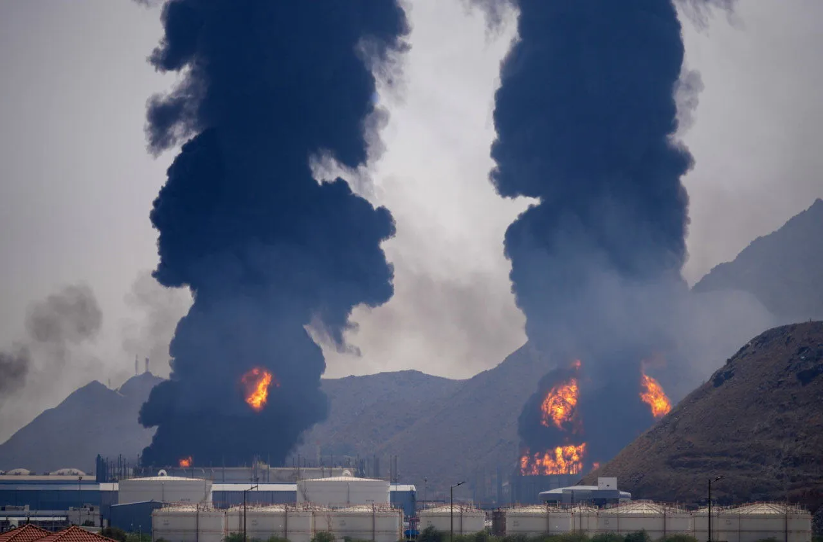
Oil and Gas Infrastructure Under Pressure
The March edition’s industry spotlight focuses on oil and gas infrastructure, which current Gulf developments have placed squarely at the centre of geopolitical and operational risk. Global demand remains structurally dependent on a small number of strategic transit routes, while AI-enabled monitoring, predictive maintenance, and automated control systems are increasing both efficiency and exposure. The implication is clear: energy systems must not only produce; they must endure disruption.
Assured Access to Orbit
The report also examines the next layer of infrastructure resilience: space. Through YAVA’s collaboration with Astraius, the March edition explores how assured access to orbit is becoming a defining factor in resilient communications and operational continuity. Satellite systems now underpin communications, navigation, surveillance, and coordination across energy, transport, and defence systems, making orbital capability an increasingly important part of terrestrial resilience.
Rocket launches and assured access to orbit are becoming critical to national infrastructure resilience, enabling secure communications, surveillance and operational continuity across defence and civilian systems.

From Geopolitical Competition to Coordinated Resilience
The report closes with a wider observation: energy corridors, satellite systems, and digital infrastructure can no longer be treated as separate domains. They are interconnected layers within a single operational environment, where disruption in one system can cascade rapidly across others. In this environment, partnerships become critical, and resilience becomes a strategic advantage.
YAVA remains focused on operating at that point of convergence, integrating secure communications, hybrid connectivity, and engineering capability into infrastructure systems designed to endure disruption rather than react to it.
The full March 2026 YAVA Monthly Report is available to download now:



Comments